


Research Methods & Techniques
The production of monoclonal antibodies dates back to 1975, when Köhler and Milstein first described the fusion of B cells from the spleens of immunized mice with cancerous myeloma cells. This process produces hybridoma cells that are both immortal and capable of secreting a specific antibody of interest.
Although mouse monoclonal antibodies provide reproducibility and specificity, they can have limited sensitivity and may be affected by antigen heterogeneity or changes in experimental conditions.
Rabbit monoclonal antibodies have emerged as an important segment of the research antibody market. Spurred by early successes in in vitro diagnostics, as well as ongoing investigation into therapeutic applications, rabbit monoclonal antibodies are increasingly used in life science research.
Scientists recognize several valuable characteristics of these antibodies, including broader reactivity with commonly studied animal tissues and a stronger, more diverse immune response compared with mouse-derived antibodies.
Although the breadth and depth of available products have not historically matched traditional mouse monoclonal antibody catalogs, the scientific community’s demand for more accurate and reliable reagents continues to drive expansion of this market.
Monoclonal Antibodies: Why Rabbits?
Scientists have used rabbits alongside mice, goats, and other animals for many decades. However, rabbits possess several unique characteristics that make them particularly well suited for monoclonal antibody production.
1. Diverse Antibody Repertoire
The antibody repertoire refers to the complete set of antibodies produced by an organism. In most species, much of the primary antibody repertoire is generated through rearrangement of the variable, diversity, and joining gene segments within developing lymphocytes. The resulting VDJ combinations can be further diversified through somatic diversification, producing the secondary antibody repertoire.
Rabbits are unusual among mammals because their ontogeny and genetic organization promote antibody diversity through different mechanisms. Although the rabbit immunoglobulin heavy-chain locus contains more than 50 functional variable gene segments, predominantly one variable gene segment is rearranged.
Consequently, much of the rabbit antibody repertoire is generated through somatic gene conversion and hypermutation. This characteristic enables rabbits to produce robust immune responses, even against compounds with relatively low immunogenicity.
2. Greater Availability of B Cells
The generation of monoclonal antibodies depends on the recovery of B cells from the spleen, bone marrow, or blood. Compared with mice and rats, the larger anatomy of rabbits can be advantageous because these tissues and samples generally contain greater quantities of recoverable B cells.
3. Heightened Immune Response
Rabbits display a naturally heightened immune response compared with many other commonly used laboratory species. The rabbit immune system can generate strong responses against small molecules, including drug molecules, steroid hormones, lipids, and glycolipids, as well as many natural and synthetic antigens.
In some cases, rabbits can produce responses without requiring carrier proteins such as keyhole limpet hemocyanin, or KLH. Avoiding or reducing dependence on a carrier protein may decrease the likelihood of generating antibodies that react with unrelated carrier-derived epitopes.
4. Outbred Laboratory Strains
Unlike many commonly used mouse and rat strains, rabbit laboratory populations are generally outbred. This genetic diversity can be advantageous because extensive inbreeding may decrease the diversity of immune responses and limit the range of antibodies produced.
5. Recognition of Additional Epitopes
The greater evolutionary distance between rabbits and humans, compared with that between rodents and humans, allows rabbits to recognize certain antigenic epitopes that may not produce a strong immune response in mice or rats.
As a result, rabbits can generate a larger and more diverse pool of target-specific antibodies. Rabbit antibodies may also display reduced immunodominance, allowing the immune response to recognize a broader range of epitopes on the same antigen. This diversity can facilitate the production of antibodies that cross-react with both rodent and human antigens. Rabbit-derived antibodies may therefore be especially useful for studying human tumor xenografts and mouse models of human disease.
6. Longer Complementarity-Determining Regions
Complementarity-determining regions, or CDRs, are segments within the variable regions of antibody heavy and light chains that participate directly in antigen binding.
Rabbit antibody heavy chains commonly possess a longer third heavy-chain CDR, known as CDR H3, compared with antibodies from several other mammalian species. CDR H3 often forms a substantial portion of the antibody’s contact surface with its antigen. This structural characteristic can contribute to the high affinity of rabbit monoclonal antibodies and their strong performance in applications such as immunohistochemistry and Western blotting.
7. Antibody Stability
Rabbit monoclonal antibodies may exhibit strong structural stability because of additional disulfide bonds. Rabbit IgG molecules contain an additional disulfide bond within the heavy-chain variable region and another disulfide bridge linking the variable and constant domains of the light chain. These structural features may contribute to the overall stability and storage performance of rabbit antibodies.
Collectively, these characteristics give rabbit monoclonal antibodies the potential to outperform traditional monoclonal antibodies in certain applications. They may provide stronger signals, improved target recognition, reduced background staining, and fewer false-positive results. As researchers continue to demand more reliable antibodies and research reagents, the development and use of rabbit monoclonal antibodies are expected to expand.
Recombinant Rabbit Monoclonal Antibody Production
The expansion of recombinant technology has unlocked additional scientific potential for monoclonal antibodies. Recombinant production can improve antibody consistency, sensitivity, specificity, scalability, and production control through sequence-defined, high-throughput manufacturing methods.
Recombinant antibodies are monoclonal antibodies produced in vitro from cloned heavy- and light-chain antibody genes. When sufficient genomic or complementary DNA sequence information is available for primer or probe design, antibody genes from virtually any antibody-producing species can be cloned for recombinant expression. High-yield plasmid DNA vectors can be introduced into host systems such as bacteria, yeast, or mammalian cells. These vectors direct the expression of cloned heavy- and light-chain genes, which assemble into functional antibody molecules within the host system. Once an antibody-producing cell line has been screened and isolated, it can be stored for extended periods and used for scalable monoclonal antibody production.
Antibody Library Construction
The development of recombinant antibodies frequently involves the construction of antibody libraries. These libraries vary according to the source of the cloned heavy- and light-chain complementary DNA sequences and are generally categorized as:
- Naive libraries
- Immune libraries
- Semi-synthetic libraries
- Fully synthetic libraries
Naive and immune libraries contain animal-derived antibody sequences. Naive libraries are generated from non-immunized animals, whereas immune libraries are generated from animals that have been immunized against a particular antigen. Antibodies obtained from immunized animals are versatile, well established, and robust because they have undergone in vivo selection and affinity maturation. They are therefore more likely to demonstrate specific recognition of the intended antigen. However, animal-derived libraries may require a more labor-intensive and time-consuming initial production phase because they depend on animal immunization and B-cell isolation.
In contrast, semi-synthetic and fully synthetic libraries derive their immunoglobulin sequences from established antibody frameworks, with additional sequence diversity intentionally introduced into the CDRs.
Advantages of Recombinant Antibody Technology
The combination of monoclonal antibody technology, recombinant DNA technology, and protein-expression systems creates a direct link between an antibody’s genotype, meaning its variable-domain genes, and its phenotype, meaning the resulting antibody’s binding characteristics. One of the most important advantages of recombinant antibody technology is the ability to select and screen antibodies for specific binding characteristics.
High-throughput in vitro display technologies, including phage, ribosome, yeast, and mammalian display, allow researchers to identify novel antibodies for a wide range of analytical, research, and clinical applications. Recombinant antibodies can also be designed to recognize either linear or conformational epitopes.
Lead antibody candidates may be further engineered to:
- Reduce immunogenicity
- Increase binding affinity
- Extend antibody half-life
- Improve manufacturing efficiency
- Enhance storage stability
- Support fusion with drugs, enzymes, or toxins
Compared with traditional hybridoma technology, recombinant antibody production offers reduced variability, increased control over antibody sequence and format, and greater potential for consistent long-term manufacturing. The method can also reduce the need for repeated animal immunizations and help ensure greater consistency between production lots.
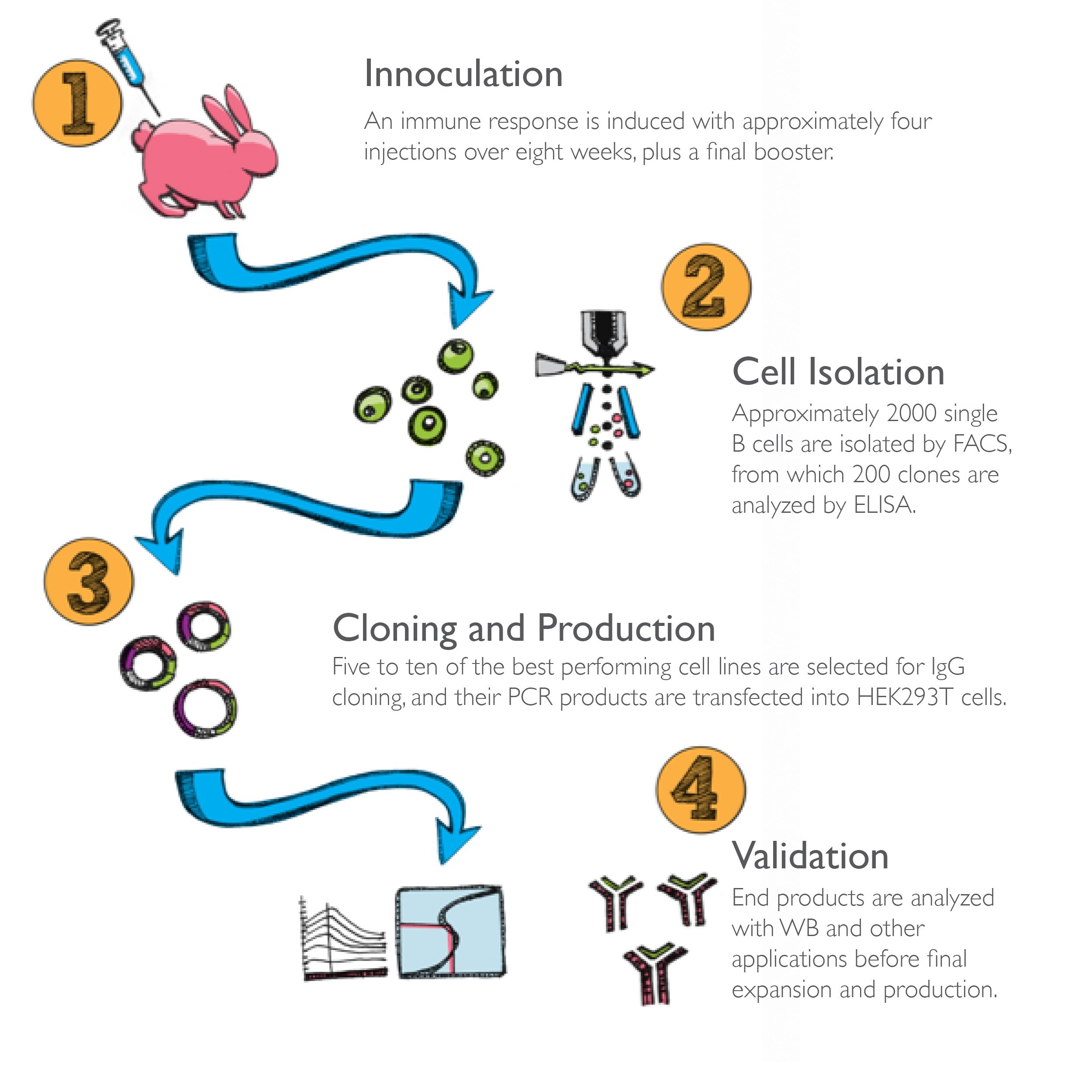
Manufacturing Process for Bioss Recombinant Rabbit Monoclonal Antibodies
Phase 1: Rabbit Immunization
- The rabbit is immunized with a specific antigen, such as a peptide or recombinant protein.
Phase 2: B-Cell Isolation and Primary Screening
- Single rabbit B cells are isolated using fluorescence-based cell-sorting methods.
- Primary antibody candidates are screened by ELISA.
Phase 3: Library Construction and Candidate Screening
- Candidate light-chain and heavy-chain complementary DNA sequences are separately cloned and amplified by reverse-transcription PCR for heterologous co-expression.
- Candidate antibodies undergo secondary screening using modified ELISA panning and quality-control PCR.
Optional Affinity Maturation
Affinity maturation may include:
- Introducing mutations into CDR hotspot residues
- Using small-perturbation mutagenesis to diversify multiple CDRs
- Constructing single-chain variable fragment or Fab sub-libraries using microchip-synthesized oligonucleotides
- Performing phage display and multiple rounds of panning
- Using Sanger sequencing or next-generation sequencing to screen individual or combinatorial CDR libraries
- Candidate antibodies undergo tertiary screening by ELISA.
Phase 4: Expression, Purification, and Application Testing
- Candidate light- and heavy-chain sequences are cloned together into a plasmid DNA expression vector.
- The expression vector is transfected into HEK293 cells.
- Antibodies are expressed and purified.
- Final antibody candidates undergo application-specific screening using methods such as:
- ELISA
- Western blotting
- Immunoprecipitation
- Immunohistochemistry
- Immunofluorescence
- Flow cytometry
The top-performing, target-specific antibodies are then selected for further development and production.
Researchers seeking a target-specific antibody may also learn more about the Bioss Custom Recombinant Rabbit Monoclonal Antibody Service.
Resources
- Kohler, G., and Milstein, C. Continuous cultures of fused cells secreting antibody of predefined specificity. Nature. 1975; 256(5517): 495-497.
- Tonegawa, S. Somatic generation of antibody diversity. Nature. 1983; 302(5909): 575-581.
- Knight, K.L., and Crane M.A. Generating the antibody repertoire in rabbit. Advances in Immunology. 1994; 56: 179-218.
- Rossi, S. et al. Rabbit Monoclonal Antibodies: A Comparative Study Between a Novel Category of Immunoreagents and the Corresponding Mouse Monoclonal Antibodies. American Journal of Clinical Pathology. 2005; 124(2): 295-302.
- Zhu, W., Li, A., and Chen, T. Rabbit Monoclonal Antibodies. Handbook of Practical Immunohistochemistry. 2015; 77-84.
- Weber, J., Peng, H., and Rader, C. From rabbit antibody repertoires to rabbit monoclonal antibodies. Experimental & Molecular Medicine. 2017; 49(3): e305.
- Kennedy, P.J., Oliveira, C., Granja, P.L., and Sarmento, B. Monoclonal antibodies: technologies for early discovery and engineering. Critical Reviews in Biotechnology. 2018; 38(3): 394-408.
0 comments