
Human Ubiquitin D (UBD) ELISA Kit
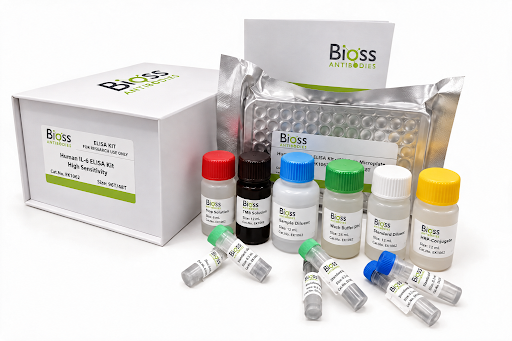
Due to the possibility of mismatching between antigens from other origin and antibodies used in our kits (e.g., antibody targets conformational epitope rather than linear epitope), some native or recombinant proteins from other manufacturers may not be recognized by our products.
Principle of the Assay
The microtiter plate provided in this kit has been pre-coated with an antibody specific to UBD. Standards or samples are then added to the appropriate microtiter plate wells with a biotin-conjugated antibody preparation specific to UBD. Next, Avidin conjugated to Horseradish Peroxidase (HRP) is added to each microplate well and incubated. After the TMB substrate solution is added, only those wells that contain UBD, biotin-conjugated antibody, and enzyme-conjugated Avidin will exhibit a change in color. The enzyme-substrate reaction is terminated by the addition of sulphuric acid solution, and the color change is measured spectrophotometrically at a wavelength of 450nm ± 10nm. The concentration of UBD in the samples is then determined by comparing the O.D. of the samples to the standard curve.
For use with: Serum, Plasma, and Other biological fluids.
For Research Use Only. Not for use in diagnostic procedures.
Target Information
Ubiquitin-like protein modifier which can be covalently attached to target protein and subsequently leads to their degradation by the 26S proteasome, in a NUB1-dependent manner. Probably functions as a survival factor. Conjugation ability activated by UBA6. Promotes the expression of the proteasome subunit beta type-9 (PSMB9/LMP2). Regulates TNF-alpha-induced and LPS-mediated activation of the central mediator of innate immunity NF-kappa-B by promoting TNF-alpha-mediated proteasomal degradation of ubiquitinated-I-kappa-B-alpha. Required for TNF-alpha-induced p65 nuclear translocation in renal tubular epithelial cells (RTECs). May be involved in dendritic cell (DC) maturation, the process by which immature dendritic cells differentiate into fully competent antigen-presenting cells that initiate T-cell responses. Mediates mitotic non-disjunction and chromosome instability, in long-term in vitro culture and cancers, by abbreviating mitotic phase and impairing the kinetochore localization of MAD2L1 during the prometaphase stage of the cell cycle. May be involved in the formation of aggresomes when proteasome is saturated or impaired. Mediates apoptosis in a caspase-dependent manner, especially in renal epithelium and tubular cells during renal diseases such as polycystic kidney disease and Human immunodeficiency virus (HIV)-associated nephropathy (HIVAN).
| GENE ID | 10537 |
| SWISS PROT | O15205 |
| SYNONYMS | UB-D; FAT10; UBD-3; Diubiquitin; Ubiquitin-like protein FAT10 |
Materials Supplied
| Kit Components | 96 Wells Quantity/Size |
|---|---|
| Pre-coated, ready-to-use 96-well strip plate | 1 plate |
| Plate sealer for 96 wells | 2 |
| Standard | 2 tubes |
| Diluent buffer | 1 bottle |
| Detection Reagent A | 1 bottle |
| Detection Reagent B | 1 bottle |
| TMB Substrate | 1 tube |
| Stop Solution | 1 tube |
| Wash Buffer (30X concentrate) | 1 tube |
| Product data sheet | 1 copy |
Storage
| Storage | The TMB Substrate, Wash Buffer (30X concentrate), and the Stop Solution should be stored at 4°C upon receipt, while the other items should be stored at -20°C. |
Performance Characteristics
| REPEATABILITY | Intra-assay Precision (Precision within an assay): 3 samples with low, middle, and high-level UBD were tested 20 times on one plate, respectively. Inter-assay Precision (Precision between assays): 3 samples with low, middle, and high-level UBD were tested on 3 different plates, with 8 replicates in each plate. CV(%) = SD/meanX100 Intra-Assay: CV<10% Inter-Assay: CV<12% |
| SENSITIVITY | The minimum detectable dose was 1.34ng/mL. |
| ASSAY RANGE | 3.12–200ng/mL |
| SPECIFICITY | This assay has high sensitivity and excellent specificity for the detection of UBD. No significant cross-reactivity or interference between UBD and analogs was observed. Note: Limited by current skills and knowledge, it is impossible to perform all possible cross-reactivity detection tests between UBD and all analogs, therefore, cross reactivity may still exist. |
Frequently asked questions
What is Human Ubiquitin D (UBD) ELISA Kit (BSKH62301) used for?
Human Ubiquitin D (UBD) ELISA Kit is used for Sandwich Elisa.
Which species does Human Ubiquitin D (UBD) ELISA Kit (BSKH62301) detect?
BSKH62301 is designed for Human samples.