
Human Caspase 4 (CASP4) ELISA Kit

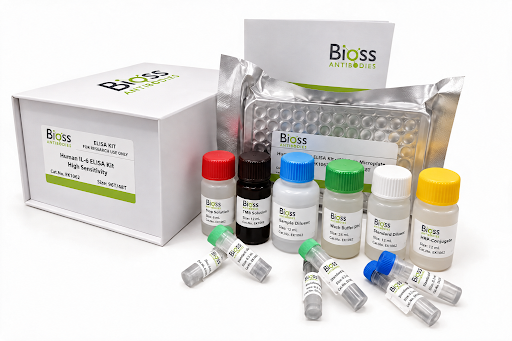
Due to the possibility of mismatching between antigens from other origin and antibodies used in our kits (e.g., antibody targets conformational epitope rather than linear epitope), some native or recombinant proteins from other manufacturers may not be recognized by our products.
Principle of the Assay
The test principle applied in this kit is Sandwich enzyme immunoassay. The microtiter plate provided in this kit has been pre-coated with an antibody specific to Human CASP4. Standards or samples are added to the appropriate microtiter plate wells then with a biotin-conjugated antibody specific to Human CASP4. Next, Avidin conjugated to Horseradish Peroxidase (HRP) is added to each microplate well and incubated. After TMB substrate solution is added, only those wells that contain Human CASP4, biotin-conjugated antibody and enzyme-conjugated Avidin will exhibit a change in color. The enzyme-substrate reaction is terminated by the addition of sulphuric acid solution and the color change is measured spectrophotometrically at a wavelength of 450nm ± 10nm. The concentration of Human CASP4 in the samples is then determined by comparing the OD of the samples to the standard curve.
For use with: tissue homogenates, cell lysates, cell culture supernates, and other biological fluids.
For Research Use Only. Not for use in diagnostic procedures.
Target Information
Inflammatory caspase that acts as an essential effector of the NLRP3 and NLRP6 inflammasomes by mediating lipopolysaccharide (LPS)-induced pyroptosis (PubMed:7797510, PubMed:23516580, PubMed:26375003, PubMed:32109412). Thiol protease that cleaves a tetrapeptide after an Asp residue at position P1: catalyzes cleavage of CGAS, GSDMD and IL18 (PubMed:7797510, PubMed:15326478, PubMed:23516580, PubMed:26375003, PubMed:28314590, PubMed:32109412). Required for innate immunity to cytosolic, but not vacuolar, bacteria (By similarity). Plays a key role in NLRP3-dependent CASP1 activation and IL1B and IL18 secretion in response to non-canonical activators, such as UVB radiation, cholera enterotoxin subunit B and cytosolic LPS (PubMed:26508369, PubMed:22246630, PubMed:23516580, PubMed:24879791, PubMed:25119034, PubMed:26173988, PubMed:26174085, PubMed:25964352). Activated by direct binding to LPS without the need of an upstream sensor (PubMed:25119034). Involved in NLRP6 inflammasome-dependent activation in response to lipoteichoic acid (LTA), a cell-wall component of Gram-positive bacteria, which leads to CASP1 activation and IL1B and IL18 secretion (PubMed:33377178). Independently of NLRP3 inflammasome and CASP1, promotes pyroptosis, through GSDMD cleavage and activation, followed by IL1A, IL18 and HMGB1 release in response to non-canonical inflammasome activators (PubMed:26375003, PubMed:32109412). Plays a crucial role in the restriction of Salmonella typhimurium replication in colonic epithelial cells during infection: in later stages of the infection, LPS from cytosolic Salmonella triggers CASP4 activation, which catalyzes cleavage of GSDMD, resulting in pyroptosis of infected cells and their extrusion into the gut lumen, as well as in IL18 secretion (PubMed:25121752, PubMed:26375003, PubMed:25964352, PubMed:34671164, PubMed:32109412). Cleavage of GSDMD is not strictly dependent on the consensus cleavage site but depends on an exosite interface on CASP4 that recognizes and binds the Gasdermin-D, C-terminal (GSDMD-CT) part (PubMed:32109412). Pyroptosis limits bacterial replication, while cytokine secretion promotes the recruitment and activation of immune cells and triggers mucosal inflammation (PubMed:25121752, PubMed:26375003, PubMed:25964352). Involved in LPS-induced IL6 secretion; this activity may not require caspase enzymatic activity (PubMed:26508369). Involved in cell death induced by endoplasmic reticulum stress and by treatment with cytotoxic APP peptides found in Alzheimer's patient brains (PubMed:23661706, PubMed:15123740, PubMed:22246630). Catalyzes cleavage and maturation of IL18 (PubMed:15326478). In contrast, it does not directly process IL1B (PubMed:7743998, PubMed:7797592, PubMed:7797510). During non-canonical inflammasome activation, cuts CGAS and may play a role in the regulation of antiviral innate immune activation (PubMed:28314590).
| GENE ID | 837 |
| SWISS PROT | P49662 |
| SYNONYMS | ICE(rel)II; ICH2; TX; Protease ICH-2; Cysteinyl Aspartate Specific Proteinases 4; Apoptosis-Related Cysteine Peptidase |
Materials Supplied
| Kit Components | 96 Wells Quantity/Size |
|---|---|
| Pre-Coated Microplate | 48T: 6 strips x 8 wells; 96T: 12 strips x 8 wells |
| Standard (Lyophilized) | 48T: 1 vial; 96T: 2 vials |
| Biotinylated Antibody (100×) | 48T: 60 μL; 96T: 120 μL |
| Streptavidin-HRP (100×) | 48T: 60 μL; 96T: 120 μL |
| Standard/Sample Diluent Buffer | 48T: 10 mL; 96T: 20 mL |
| Biotinylated Antibody Diluent | 48T: 6 mL; 96T: 12 mL |
| HRP Diluent | 48T: 6 mL; 96T: 12 mL |
| Wash Buffer (25×) | 48T: 10 mL; 96T: 20 mL |
| TMB Substrate Solution | 48T: 6 mL; 96T: 10 mL |
| Stop Reagent | 48T: 3 mL; 96T: 6 mL |
| Plate Covers | 48T: 1 piece; 96T: 2 pieces |
Storage
| Storage | *If the kit is opened, Store the whole kit at 4°C. If the kit is not used up in 1 week. Store the Pre-Coated Microplate, Standard ,Biotinylated Antibody and Streptavidin-HRP at -20°C, the rest reagents at 4°C, please used up within 6 months. *If the kit is not opened, store the whole kit: 4°C(short time storage, valid for 6 months); -20°C (long-term storage, valid for 1 year). Avoid repeated freeze-thaw cycles. |
Performance Characteristics
| REPEATABILITY | Intra-assay Precision (Precision within an assay):CV% < 8% Three samples of known concentration were tested twenty times on 1 plate to assess intra-assay precision. Inter-assay Precision (precision between assays):CV% < 10% Three samples of known concentration were tested in forty separate assays to assess inter-assay precision. |
| SENSITIVITY | The minimum detectable dose was 0.059ng/mL. |
| ASSAY RANGE | 0.16–10ng/mL |
| SPECIFICITY | This assay has high sensitivity and excellent specificity for detection of Human CASP4. No significant cross-reactivity or interference between Human CASP4 and analogues was observed. |
Frequently asked questions
What is Human Caspase 4 (CASP4) ELISA Kit (BSKH72899) used for?
Human Caspase 4 (CASP4) ELISA Kit is used for Sandwich Elisa.
Which species does Human Caspase 4 (CASP4) ELISA Kit (BSKH72899) detect?
BSKH72899 is designed for Human samples.