
Human E1A Binding Protein P300 (EP300) ELISA Kit

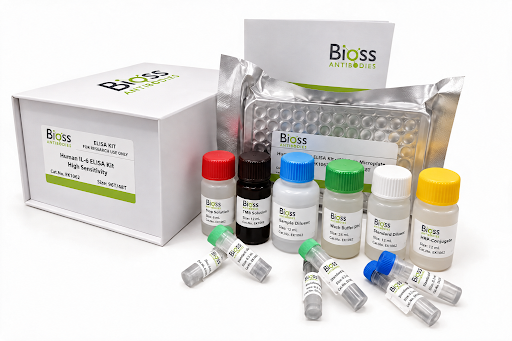
Due to the possibility of mismatching between antigens from other origin and antibodies used in our kits (e.g., antibody targets conformational epitope rather than linear epitope), some native or recombinant proteins from other manufacturers may not be recognized by our products.
Principle of the Assay
The test principle applied in this kit is Sandwich enzyme immunoassay. The microtiter plate provided in this kit has been pre-coated with an antibody specific to Human EP300. Standards or samples are added to the appropriate microtiter plate wells then with a biotin-conjugated antibody specific to Human EP300. Next, Avidin conjugated to Horseradish Peroxidase (HRP) is added to each microplate well and incubated. After TMB substrate solution is added, only those wells that contain Human EP300, biotin-conjugated antibody and enzyme-conjugated Avidin will exhibit a change in color. The enzyme-substrate reaction is terminated by the addition of sulphuric acid solution and the color change is measured spectrophotometrically at a wavelength of 450nm ± 10nm. The concentration of Human EP300 in the samples is then determined by comparing the OD of the samples to the standard curve.
For use with: Tissue homogenates, cell lysates, and other biological fluids.
For Research Use Only. Not for use in diagnostic procedures.
Target Information
Functions as histone acetyltransferase and regulates transcription via chromatin remodeling (PubMed:23415232, PubMed:23934153, PubMed:8945521). Acetylates all four core histones in nucleosomes. Histone acetylation gives an epigenetic tag for transcriptional activation (PubMed:23415232, PubMed:23934153, PubMed:8945521). Mediates cAMP-gene regulation by binding specifically to phosphorylated CREB protein. Mediates acetylation of histone H3 at 'Lys-122' (H3K122ac), a modification that localizes at the surface of the histone octamer and stimulates transcription, possibly by promoting nucleosome instability. Mediates acetylation of histone H3 at 'Lys-27' (H3K27ac) (PubMed:23911289). Also functions as acetyltransferase for non-histone targets, such as ALX1, HDAC1, PRMT1 or SIRT2 (PubMed:12929931, PubMed:16762839, PubMed:18722353). Acetylates 'Lys-131' of ALX1 and acts as its coactivator (PubMed:12929931). Acetylates SIRT2 and is proposed to indirectly increase the transcriptional activity of p53/TP53 through acetylation and subsequent attenuation of SIRT2 deacetylase function (PubMed:18722353). Following DNA damage, forms a stress-responsive p53/TP53 coactivator complex with JMY which mediates p53/TP53 acetylation, thereby increasing p53/TP53-dependent transcription and apoptosis (PubMed:11511361, PubMed:15448695). Promotes chromatin acetylation in heat shock responsive HSP genes during the heat shock response (HSR), thereby stimulating HSR transcription (PubMed:18451878). Acetylates HDAC1 leading to its inactivation and modulation of transcription (PubMed:16762839). Acetylates 'Lys-247' of EGR2 (By similarity). Acts as a TFAP2A-mediated transcriptional coactivator in presence of CITED2 (PubMed:12586840). Plays a role as a coactivator of NEUROD1-dependent transcription of the secretin and p21 genes and controls terminal differentiation of cells in the intestinal epithelium. Promotes cardiac myocyte enlargement. Can also mediate transcriptional repression. Acetylates FOXO1 and enhances its transcriptional activity (PubMed:15890677). Acetylates BCL6 wich disrupts its ability to recruit histone deacetylases and hinders its transcriptional repressor activity (PubMed:12402037). Participates in CLOCK or NPAS2-regulated rhythmic gene transcription; exhibits a circadian association with CLOCK or NPAS2, correlating with increase in PER1/2 mRNA and histone H3 acetylation on the PER1/2 promoter (PubMed:14645221). Acetylates MTA1 at 'Lys-626' which is essential for its transcriptional coactivator activity (PubMed:16617102). Acetylates XBP1 isoform 2; acetylation increases protein stability of XBP1 isoform 2 and enhances its transcriptional activity (PubMed:20955178). Acetylates PCNA; acetylation promotes removal of chromatin-bound PCNA and its degradation during nucleotide excision repair (NER) (PubMed:24939902). Acetylates MEF2D (PubMed:21030595). Acetylates and stabilizes ZBTB7B protein by antagonizing ubiquitin conjugation and degradation, this mechanism may be involved in CD4/CD8 lineage differentiation (PubMed:20810990). Acetylates GABPB1, impairing GABPB1 heterotetramerization and activity (By similarity). Acetylates PCK1 and promotes PCK1 anaplerotic activity (PubMed:30193097). Acetylates RXRA and RXRG (PubMed:17761950). Acetylates isoform M2 of PKM (PKM2), promoting its homodimerization and conversion into a protein kinase (PubMed:24120661). In addition to protein acetyltransferase, can use different acyl-CoA substrates, such as (2E)-butenoyl-CoA (crotonyl-CoA), butanoyl-CoA (butyryl-CoA), 2-hydroxyisobutanoyl-CoA (2-hydroxyisobutyryl-CoA), lactoyl-CoA or propanoyl-CoA (propionyl-CoA), and is able to mediate protein crotonylation, butyrylation, 2-hydroxyisobutyrylation, lactylation or propionylation, respectively (PubMed:17267393, PubMed:25818647, PubMed:29775581, PubMed:31645732). Acts as a histone crotonyltransferase; crotonylation marks active promoters and enhancers and confers resistance to transcriptional repressors (PubMed:25818647). Histone crotonyltransferase activity is dependent on the concentration of (2E)-butenoyl-CoA (crotonyl-CoA) substrate and such activity is weak when (2E)-butenoyl-CoA (crotonyl-CoA) concentration is low (PubMed:25818647). Also acts as a histone butyryltransferase; butyrylation marks active promoters (PubMed:17267393). Catalyzes histone lactylation in macrophages by using lactoyl-CoA directly derived from endogenous or exogenous lactate, leading to stimulates gene transcription (PubMed:31645732). Acts as a protein-lysine 2-hydroxyisobutyryltransferase; regulates glycolysis by mediating 2-hydroxyisobutyrylation of glycolytic enzymes (PubMed:29775581). Functions as a transcriptional coactivator for SMAD4 in the TGF-beta signaling pathway (PubMed:25514493).
| GENE ID | 2033 |
| SWISS PROT | Q09472 |
| SYNONYMS | KAT3B; p300; Histone Acetyltransferase p300 |
Materials Supplied
| Kit Components | 96 Wells Quantity/Size |
|---|---|
| Pre-Coated Microplate | 48T: 6 strips x 8 wells; 96T: 12 strips x 8 wells |
| Standard (Lyophilized) | 48T: 1 vial; 96T: 2 vials |
| Biotinylated Antibody (100×) | 48T: 60 μL; 96T: 120 μL |
| Streptavidin-HRP (100×) | 48T: 60 μL; 96T: 120 μL |
| Standard/Sample Diluent Buffer | 48T: 10 mL; 96T: 20 mL |
| Biotinylated Antibody Diluent | 48T: 6 mL; 96T: 12 mL |
| HRP Diluent | 48T: 6 mL; 96T: 12 mL |
| Wash Buffer (25×) | 48T: 10 mL; 96T: 20 mL |
| TMB Substrate Solution | 48T: 6 mL; 96T: 10 mL |
| Stop Reagent | 48T: 3 mL; 96T: 6 mL |
| Plate Covers | 48T: 1 piece; 96T: 2 pieces |
Storage
| Storage | *If the kit is opened, Store the whole kit at 4°C. If the kit is not used up in 1 week. Store the Pre-Coated Microplate, Standard ,Biotinylated Antibody and Streptavidin-HRP at -20°C, the rest reagents at 4°C, please used up within 6 months. *If the kit is not opened, store the whole kit: 4°C(short time storage, valid for 6 months); -20°C (long-term storage, valid for 1 year). Avoid repeated freeze-thaw cycles. |
Performance Characteristics
| REPEATABILITY | Intra-assay Precision (Precision within an assay):CV% < 8% Three samples of known concentration were tested twenty times on 1 plate to assess intra-assay precision. Inter-assay Precision (precision between assays):CV% < 10% Three samples of known concentration were tested in forty separate assays to assess inter-assay precision. |
| SENSITIVITY | The minimum detectable dose was 0.054ng/mL. |
| ASSAY RANGE | 0.16–10ng/mL |
| SPECIFICITY | This assay has high sensitivity and excellent specificity for detection of Human EP300. No significant cross-reactivity or interference between Human EP300 and analogues was observed. |
Frequently asked questions
What is Human E1A Binding Protein P300 (EP300) ELISA Kit (BSKH73058) used for?
Human E1A Binding Protein P300 (EP300) ELISA Kit is used for Sandwich Elisa.
Which species does Human E1A Binding Protein P300 (EP300) ELISA Kit (BSKH73058) detect?
BSKH73058 is designed for Human samples.