
Human Cathepsin G (CTSG) ELISA Kit

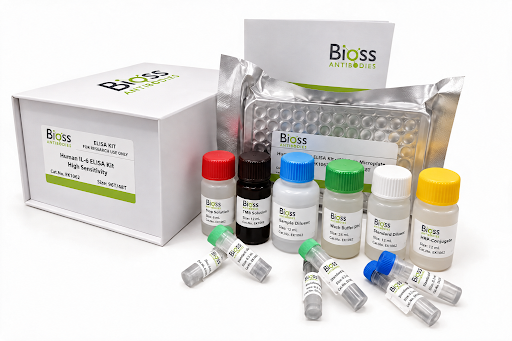
Due to the possibility of mismatching between antigens from other origin and antibodies used in our kits (e.g., antibody targets conformational epitope rather than linear epitope), some native or recombinant proteins from other manufacturers may not be recognized by our products.
Principle of the Assay
The test principle applied in this kit is Sandwich enzyme immunoassay. The microtiter plate provided in this kit has been pre-coated with an antibody specific to Human CTSG. Standards or samples are added to the appropriate microtiter plate wells then with a biotin-conjugated antibody specific to Human CTSG. Next, Avidin conjugated to Horseradish Peroxidase (HRP) is added to each microplate well and incubated. After TMB substrate solution is added, only those wells that contain Human CTSG, biotin-conjugated antibody and enzyme-conjugated Avidin will exhibit a change in color. The enzyme-substrate reaction is terminated by the addition of sulphuric acid solution and the color change is measured spectrophotometrically at a wavelength of 450nm ± 10nm. The concentration of Human CTSG in the samples is then determined by comparing the OD of the samples to the standard curve.
For use with: serum, plasma, tissue homogenates, cell lysates, and other biological fluids.
For Research Use Only. Not for use in diagnostic procedures.
Target Information
Serine protease with trypsin- and chymotrypsin-like specificity (PubMed:8194606, PubMed:29652924). Also displays antibacterial activity against Gram-negative and Gram-positive bacteria independent of its protease activity (PubMed:2116408, PubMed:2117044). Prefers Phe and Tyr residues in the P1 position of substrates but also cleaves efficiently after Trp and Leu (PubMed:29652924). Shows a preference for negatively charged amino acids in the P2' position and for aliphatic amino acids both upstream and downstream of the cleavage site (PubMed:29652924). Required for recruitment and activation of platelets which is mediated by the F2RL3/PAR4 platelet receptor (PubMed:3390156, PubMed:10702240). Binds reversibly to and stimulates B cells and CD4(+) and CD8(+) T cells (PubMed:7842483, PubMed:9000539). Also binds reversibly to natural killer (NK) cells and enhances NK cell cytotoxicity through its protease activity (PubMed:9000539, PubMed:9536127). Cleaves complement C3 (PubMed:1861080). Cleaves vimentin (By similarity). Cleaves thrombin receptor F2R/PAR1 and acts as either an agonist or an inhibitor, depending on the F2R cleavage site (PubMed:10702240, PubMed:7744748). Cleavage of F2R at '41-Arg-|-Ser-42' results in receptor activation while cleavage at '55-Phe-|-Trp-56' results in inhibition of receptor activation (PubMed:7744748). Cleaves the synovial mucin-type protein PRG4/lubricin (PubMed:32144329). Cleaves and activates IL36G which promotes expression of chemokines CXCL1 and CXLC8 in keratinocytes (PubMed:30804664). Cleaves IL33 into mature forms which have greater activity than the unprocessed form (PubMed:22307629). Cleaves coagulation factor F8 to produce a partially activated form (PubMed:18217133). Also cleaves and activates coagulation factor F10 (PubMed:8920993). Cleaves leukocyte cell surface protein SPN/CD43 to releases its extracellular domain and trigger its intramembrane proteolysis by gamma-secretase, releasing the CD43 cytoplasmic tail chain (CD43-ct) which translocates to the nucleus (PubMed:18586676). Cleaves CCL5/RANTES to produce RANTES(4-68) lacking the N-terminal three amino acids which exhibits reduced chemotactic and antiviral activities (PubMed:16963625). During apoptosis, cleaves SMARCA2/BRM to produce a 160 kDa cleavage product which localizes to the cytosol (PubMed:11259672). Cleaves myelin basic protein MBP in B cell lysosomes at '224-Phe-|-Lys-225' and '248-Phe-|-Ser-249', degrading the major immunogenic MBP epitope and preventing the activation of MBP-specific autoreactive T cells (PubMed:15100291). Cleaves annexin ANXA1 and antimicrobial peptide CAMP to produce peptides which act on neutrophil N-formyl peptide receptors to enhance the release of CXCL2 (PubMed:22879591). Acts as a ligand for the N-formyl peptide receptor FPR1, enhancing phagocyte chemotaxis (PubMed:15210802). Has antibacterial activity against the Gram-negative bacteria N.gonorrhoeae and P.aeruginosa (PubMed:2116408, PubMed:1937776). Likely to act against N.gonorrhoeae by interacting with N.gonorrhoeae penA/PBP2 (PubMed:2126324). Exhibits potent antimicrobial activity against the Gram-positive bacterium L.monocytogenes (PubMed:2117044). Has antibacterial activity against the Gram-positive bacterium S.aureus and degrades S.aureus biofilms, allowing polymorphonuclear leukocytes to penetrate the biofilm and phagocytose bacteria (PubMed:2117044, PubMed:32995850). Has antibacterial activity against M.tuberculosis (PubMed:15385470). Mediates CASP4 activation induced by the Td92 surface protein of the periodontal pathogen T.denticola, causing production and secretion of IL1A and leading to pyroptosis of gingival fibroblasts (PubMed:29077095).
| GENE ID | 1511 |
| SWISS PROT | P08311 |
| SYNONYMS | CG; CTS-G |
Materials Supplied
| Kit Components | 96 Wells Quantity/Size |
|---|---|
| Pre-Coated Microplate | 48T: 6 strips x 8 wells; 96T: 12 strips x 8 wells |
| Standard (Lyophilized) | 48T: 1 vial; 96T: 2 vials |
| Biotinylated Antibody (100×) | 48T: 60 μL; 96T: 120 μL |
| Streptavidin-HRP (100×) | 48T: 60 μL; 96T: 120 μL |
| Standard/Sample Diluent Buffer | 48T: 10 mL; 96T: 20 mL |
| Biotinylated Antibody Diluent | 48T: 6 mL; 96T: 12 mL |
| HRP Diluent | 48T: 6 mL; 96T: 12 mL |
| Wash Buffer (25×) | 48T: 10 mL; 96T: 20 mL |
| TMB Substrate Solution | 48T: 6 mL; 96T: 10 mL |
| Stop Reagent | 48T: 3 mL; 96T: 6 mL |
| Plate Covers | 48T: 1 piece; 96T: 2 pieces |
Storage
| Storage | *If the kit is opened, Store the whole kit at 4°C. If the kit is not used up in 1 week. Store the Pre-Coated Microplate, Standard ,Biotinylated Antibody and Streptavidin-HRP at -20°C, the rest reagents at 4°C, please used up within 6 months. *If the kit is not opened, store the whole kit: 4°C(short time storage, valid for 6 months); -20°C (long-term storage, valid for 1 year). Avoid repeated freeze-thaw cycles. |
Performance Characteristics
| REPEATABILITY | Intra-assay Precision (Precision within an assay):CV% < 8% Three samples of known concentration were tested twenty times on 1 plate to assess intra-assay precision. Inter-assay Precision (precision between assays):CV% < 10% Three samples of known concentration were tested in forty separate assays to assess inter-assay precision. |
| SENSITIVITY | The minimum detectable dose was 0.06ng/mL. |
| ASSAY RANGE | 0.16–10ng/mL |
| SPECIFICITY | This assay has high sensitivity and excellent specificity for detection of Human CTSG. No significant cross-reactivity or interference between Human CTSG and analogues was observed. |
Frequently asked questions
What is Human Cathepsin G (CTSG) ELISA Kit (BSKH73155) used for?
Human Cathepsin G (CTSG) ELISA Kit is used for Sandwich Elisa.
Which species does Human Cathepsin G (CTSG) ELISA Kit (BSKH73155) detect?
BSKH73155 is designed for Human samples.