
Mouse Midkine (MK) ELISA Kit

Due to the possibility of mismatching between antigens from other origin and antibodies used in our kits (e.g., antibody targets conformational epitope rather than linear epitope), some native or recombinant proteins from other manufacturers may not be recognized by our products.
Principle of the Assay
The test principle applied in this kit is Sandwich enzyme immunoassay. The microtiter plate provided in this kit has been pre-coated with an antibody specific to Mouse MK. Standards or samples are added to the appropriate microtiter plate wells then with a biotin-conjugated antibody specific to Mouse MK. Next, Avidin conjugated to Horseradish Peroxidase (HRP) is added to each microplate well and incubated. After TMB substrate solution is added, only those wells that contain Mouse MK, biotin-conjugated antibody and enzyme-conjugated Avidin will exhibit a change in color. The enzyme-substrate reaction is terminated by the addition of sulphuric acid solution and the color change is measured spectrophotometrically at a wavelength of 450nm ± 10nm. The concentration of Mouse MK in the samples is then determined by comparing the OD of the samples to the standard curve.
For use with: serum, plasma, tissue homogenates, cell lysates, cell culture supernates, and other biological fluids.
For Research Use Only. Not for use in diagnostic procedures.
Target Information
Secreted protein that functions as cytokine and growth factor and mediates its signal through cell-surface proteoglycan and non-proteoglycan receptors (PubMed:16901907). Binds cell-surface proteoglycan receptors via their chondroitin sulfate (CS) groups (PubMed:17230638). Thereby regulates many processes like inflammatory response, cell proliferation, cell adhesion, cell growth, cell survival, tissue regeneration, cell differentiation and cell migration (PubMed:17230638, PubMed:19060126, PubMed:17015789, PubMed:28183532, PubMed:10683378, PubMed:15482347, PubMed:15509530, PubMed:24458438, PubMed:25551381, PubMed:29233575). Participates in inflammatory processes by exerting two different activities. Firstly, mediates neutrophils and macrophages recruitment to the sites of inflammation both by direct action by cooperating namely with ITGB2 via LRP1 and by inducing chemokine expression (PubMed:10683378, PubMed:15509530, PubMed:24458438, PubMed:28183532). This inflammation can be accompanied by epithelial cell survival and smooth muscle cell migration after renal and vessel damage, respectively (PubMed:15509530, PubMed:10683378). Secondly, suppresses the development of tolerogenic dendric cells thereby inhibiting the differentiation of regulatory T cells and also promote T cell expansion through NFAT signaling and Th1 cell differentiation (PubMed:28183532). Promotes tissue regeneration after injury or trauma. After heart damage negatively regulates the recruitment of inflammatory cells and mediates cell survival through activation of anti-apoptotic signaling pathways via MAPKs and AKT pathways through the activation of angiogenesis (PubMed:17015789, PubMed:19060126). Also facilitates liver regeneration as well as bone repair by recruiting macrophage at trauma site and by promoting cartilage development by facilitating chondrocyte differentiation (PubMed:15482347, PubMed:25551381). Plays a role in brain by promoting neural precursor cells survival and growth through interaction with heparan sulfate proteoglycans (PubMed:17230638). Binds PTPRZ1 and promotes neuronal migration and embryonic neurons survival (By similarity). Binds SDC3 or GPC2 and mediates neurite outgrowth and cell adhesion (By similarity). Binds chondroitin sulfate E and heparin leading to inhibition of neuronal cell adhesion induced by binding with GPC2 (PubMed:10978312). Binds CSPG5 and promotes elongation of oligodendroglial precursor-like cells (PubMed:16901907). Also binds ITGA6:ITGB1 complex; this interaction mediates MDK-induced neurite outgrowth (By similarity). Binds LRP1; promotes neuronal survival (By similarity). Binds ITGA4:ITGB1 complex; this interaction mediates MDK-induced osteoblast cells migration through PXN phosphorylation (By similarity). Binds anaplastic lymphoma kinase (ALK) which induces ALK activation and subsequent phosphorylation of the insulin receptor substrate (IRS1), followed by the activation of mitogen-activated protein kinase (MAPK) and PI3-kinase, and the induction of cell proliferation (By similarity). Promotes epithelial to mesenchymal transition through interaction with NOTCH2 (By similarity). During arteriogenesis, plays a role in vascular endothelial cell proliferation by inducing VEGFA expression and release which in turn induces nitric oxide synthase expression. Moreover activates vasodilation through nitric oxide synthase activation (PubMed:29233575). Negatively regulates bone formation in response to mechanical load by inhibiting Wnt/beta-catenin signaling in osteoblasts (PubMed:21185956, PubMed:20200993). In addition plays a role in hippocampal development, working memory, auditory response, early fetal adrenal gland development and the female reproductive system (PubMed:16619002, PubMed:17121547, PubMed:10096022).
| GENE ID | 17242 |
| SWISS PROT | P12025 |
| SYNONYMS | MDK; ARAP; NEGF2; Neurite Growth-Promoting Factor 2; Amphiregulin-associated protein; Midgestation and kidney protein; Neurite outgrowth-promoting factor 2 |
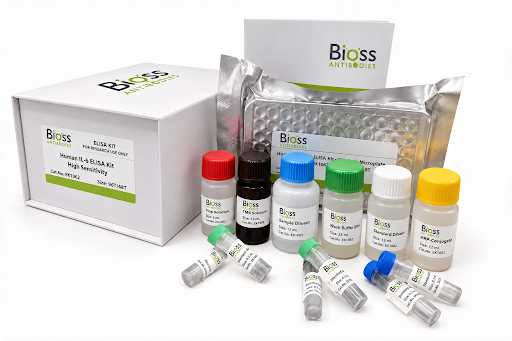
Materials Supplied
| Kit Components | 96 Wells Quantity/Size |
|---|---|
| Pre-Coated Microplate | 48T: 6 strips x 8 wells; 96T: 12 strips x 8 wells |
| Standard (Lyophilized) | 48T: 1 vial; 96T: 2 vials |
| Biotinylated Antibody (100×) | 48T: 60 μL; 96T: 120 μL |
| Streptavidin-HRP (100×) | 48T: 60 μL; 96T: 120 μL |
| Standard/Sample Diluent Buffer | 48T: 10 mL; 96T: 20 mL |
| Biotinylated Antibody Diluent | 48T: 6 mL; 96T: 12 mL |
| HRP Diluent | 48T: 6 mL; 96T: 12 mL |
| Wash Buffer (25×) | 48T: 10 mL; 96T: 20 mL |
| TMB Substrate Solution | 48T: 6 mL; 96T: 10 mL |
| Stop Reagent | 48T: 3 mL; 96T: 6 mL |
| Plate Covers | 48T: 1 piece; 96T: 2 pieces |
Storage
| Storage | *If the kit is opened, Store the whole kit at 4°C. If the kit is not used up in 1 week. Store the Pre-Coated Microplate, Standard ,Biotinylated Antibody and Streptavidin-HRP at -20°C, the rest reagents at 4°C, please used up within 6 months. *If the kit is not opened, store the whole kit: 4°C(short time storage, valid for 6 months); -20°C (long-term storage, valid for 1 year). Avoid repeated freeze-thaw cycles. |
Performance Characteristics
| REPEATABILITY | Intra-assay Precision (Precision within an assay):CV% < 8% Three samples of known concentration were tested twenty times on 1 plate to assess intra-assay precision. Inter-assay Precision (precision between assays):CV% < 10% Three samples of known concentration were tested in forty separate assays to assess inter-assay precision. |
| SENSITIVITY | The minimum detectable dose was 0.057ng/mL. |
| ASSAY RANGE | 0.16–10ng/mL |
| SPECIFICITY | This assay has high sensitivity and excellent specificity for detection of Mouse MK. No significant cross-reactivity or interference between Mouse MK and analogues was observed. |
Frequently asked questions
What is Mouse Midkine (MK) ELISA Kit (BSKM71403) used for?
Mouse Midkine (MK) ELISA Kit is used for Sandwich Elisa.
Which species does Mouse Midkine (MK) ELISA Kit (BSKM71403) detect?
BSKM71403 is designed for Mouse samples.