
Mouse Sirtuin 6 (SIRT6) ELISA Kit

Due to the possibility of mismatching between antigens from other origin and antibodies used in our kits (e.g., antibody targets conformational epitope rather than linear epitope), some native or recombinant proteins from other manufacturers may not be recognized by our products.
Principle of the Assay
The test principle applied in this kit is Sandwich enzyme immunoassay. The microtiter plate provided in this kit has been pre-coated with an antibody specific to Mouse SIRT6. Standards or samples are added to the appropriate microtiter plate wells then with a biotin-conjugated antibody specific to Mouse SIRT6. Next, Avidin conjugated to Horseradish Peroxidase (HRP) is added to each microplate well and incubated. After TMB substrate solution is added, only those wells that contain Mouse SIRT6, biotin-conjugated antibody and enzyme-conjugated Avidin will exhibit a change in color. The enzyme-substrate reaction is terminated by the addition of sulphuric acid solution and the color change is measured spectrophotometrically at a wavelength of 450nm ± 10nm. The concentration of Mouse SIRT6 in the samples is then determined by comparing the OD of the samples to the standard curve.
For use with: Tissue homogenates, cell lysates, and other biological fluids.
For Research Use Only. Not for use in diagnostic procedures.
Target Information
NAD-dependent protein deacetylase, deacylase and mono-ADP-ribosyltransferase that plays an essential role in DNA damage repair, telomere maintenance, metabolic homeostasis, inflammation, tumorigenesis and aging (PubMed:16439206, PubMed:19135889, PubMed:20141841, PubMed:19220062, PubMed:19597350, PubMed:23217706, PubMed:23911928, PubMed:27180906, PubMed:29599436). Displays protein-lysine deacetylase or defatty-acylase (demyristoylase and depalmitoylase) activity, depending on the context (By similarity). Acts as a key histone deacetylase by catalyzing deacetylation of histone H3 at 'Lys-9', 'Lys-18' and 'Lys-56' (H3K9ac, H3K18ac and H3K56ac, respectively), suppressing target gene expression of several transcription factors, including NF-kappa-B (PubMed:19135889, PubMed:19597350, PubMed:20816089, PubMed:21098266, PubMed:25915124, PubMed:28871079, PubMed:31002797, PubMed:31399344). Acts as an inhibitor of transcription elongation by mediating deacetylation of H3K9ac and H3K56ac, preventing release of NELFE from chromatin and causing transcriptional pausing (PubMed:31399344). Involved in DNA repair by promoting double-strand break (DSB) repair: acts as a DSB sensor by recognizing and binding DSB sites, leading to (1) recruitment of DNA repair proteins, such as SMARCA5/SNF2H, and (2) deacetylation of histone H3K9ac and H3K56ac (PubMed:32538779). SIRT6 participation to DSB repair is probably involved in extension of life span (PubMed:22367546, PubMed:31002797). Also promotes DNA repair by deacetylating non-histone proteins, such as DDB2 and p53/TP53 (By similarity). Specifically deacetylates H3K18ac at pericentric heterochromatin, thereby maintaining pericentric heterochromatin silencing at centromeres and protecting against genomic instability and cellular senescence (By similarity). Involved in telomere maintenance by catalyzing deacetylation of histone H3 in telomeric chromatin, regulating telomere position effect and telomere movement in response to DNA damage (PubMed:29599436). Required for embryonic stem cell differentiation by mediating histone deacetylation of H3K9ac (PubMed:25915124, PubMed:29555651). Plays a major role in metabolism by regulating processes such as glycolysis, gluconeogenesis, insulin secretion and lipid metabolism (PubMed:20141841, PubMed:20816089, PubMed:20847051, PubMed:21098266, PubMed:23974119, PubMed:27457971, PubMed:28355567, PubMed:28250020, PubMed:34050173). Inhibits glycolysis via histone deacetylase activity and by acting as a corepressor of the transcription factor HIF1A, thereby controlling the expression of multiple glycolytic genes (PubMed:20141841). Has tumor suppressor activity by repressing glycolysis, thereby inhibiting the Warburg effect (PubMed:23217706). Also regulates glycolysis and tumorigenesis by mediating deacetylation and nuclear export of non-histone proteins, such as isoform M2 of PKM (PKM2) (By similarity). Acts as a negative regulator of gluconeogenesis by mediating deacetylation of non-histone proteins, such as FOXO1 and KAT2A/GCN5 (PubMed:23142079, PubMed:25009184). Promotes beta-oxidation of fatty acids during fasting by catalyzing deacetylation of NCOA2, inducing coactivation of PPARA (PubMed:31851938). Acts as a regulator of lipid catabolism in brown adipocytes, both by catalyzing deacetylation of histones and non-histone proteins, such as FOXO1 (PubMed:28723567, PubMed:31442424). Also acts as a regulator of circadian rhythms, both by regulating expression of clock-controlled genes involved in lipid and carbohydrate metabolism, and by catalyzing deacetylation of PER2 (PubMed:25083875, PubMed:30782483). The defatty-acylase activity is specifically involved in regulation of protein secretion (PubMed:19151729, PubMed:27322069). Has high activity toward long-chain fatty acyl groups and mediates protein-lysine demyristoylation and depalmitoylation of target proteins, such as RRAS2 and TNF, thereby regulating their secretion (By similarity). Also acts as a mono-ADP-ribosyltransferase by mediating mono-ADP-ribosylation of PARP1, TRIM28/KAP1 or SMARCC2/BAF170 (PubMed:15795229, PubMed:21680843, PubMed:25247314, PubMed:31216030). Mono-ADP-ribosyltransferase activity is involved in DNA repair, cellular senescence, repression of LINE-1 retrotransposon elements and regulation of transcription (PubMed:21680843, PubMed:25247314, PubMed:30853213, PubMed:31216030, PubMed:32584788).
| GENE ID | 50721 |
| SWISS PROT | P59941 |
| SYNONYMS | SIR2L6; Silent Mating Type Information Regulation 2 Homolog 6; Mono-ADP-Ribosyltransferase Sirtuin-6; Regulatory protein SIR2 homolog 6; SIR2-like protein 6 |
Materials Supplied
| Kit Components | 96 Wells Quantity/Size |
|---|---|
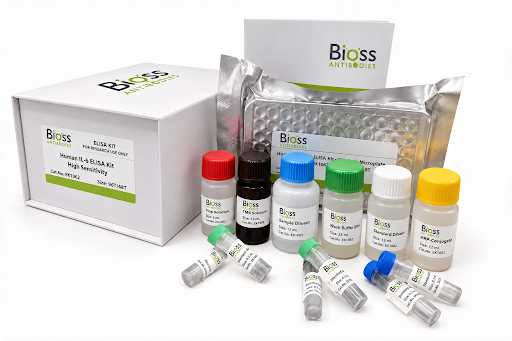
| Pre-Coated Microplate | 48T: 6 strips x 8 wells; 96T: 12 strips x 8 wells |
| Standard (Lyophilized) | 48T: 1 vial; 96T: 2 vials |
| Biotinylated Antibody (100×) | 48T: 60 μL; 96T: 120 μL |
| Streptavidin-HRP (100×) | 48T: 60 μL; 96T: 120 μL |
| Standard/Sample Diluent Buffer | 48T: 10 mL; 96T: 20 mL |
| Biotinylated Antibody Diluent | 48T: 6 mL; 96T: 12 mL |
| HRP Diluent | 48T: 6 mL; 96T: 12 mL |
| Wash Buffer (25×) | 48T: 10 mL; 96T: 20 mL |
| TMB Substrate Solution | 48T: 6 mL; 96T: 10 mL |
| Stop Reagent | 48T: 3 mL; 96T: 6 mL |
| Plate Covers | 48T: 1 piece; 96T: 2 pieces |
Storage
| Storage | *If the kit is opened, Store the whole kit at 4°C. If the kit is not used up in 1 week. Store the Pre-Coated Microplate, Standard ,Biotinylated Antibody and Streptavidin-HRP at -20°C, the rest reagents at 4°C, please used up within 6 months. *If the kit is not opened, store the whole kit: 4°C(short time storage, valid for 6 months); -20°C (long-term storage, valid for 1 year). Avoid repeated freeze-thaw cycles. |
Performance Characteristics
| REPEATABILITY | Intra-assay Precision (Precision within an assay):CV% < 8% Three samples of known concentration were tested twenty times on 1 plate to assess intra-assay precision. Inter-assay Precision (precision between assays):CV% < 10% Three samples of known concentration were tested in forty separate assays to assess inter-assay precision. |
| SENSITIVITY | The minimum detectable dose was 0.057ng/mL. |
| ASSAY RANGE | 0.16–10ng/mL |
| SPECIFICITY | This assay has high sensitivity and excellent specificity for detection of Mouse SIRT6. No significant cross-reactivity or interference between Mouse SIRT6 and analogues was observed. |
Frequently asked questions
What is Mouse Sirtuin 6 (SIRT6) ELISA Kit (BSKM71577) used for?
Mouse Sirtuin 6 (SIRT6) ELISA Kit is used for Sandwich Elisa.
Which species does Mouse Sirtuin 6 (SIRT6) ELISA Kit (BSKM71577) detect?
BSKM71577 is designed for Mouse samples.