


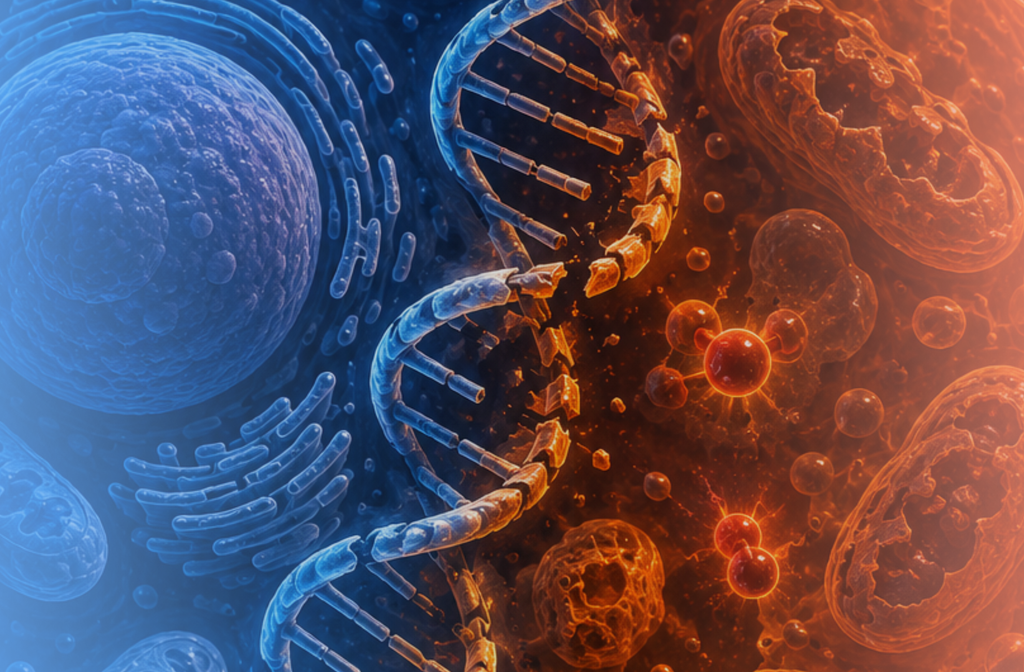
Oxidative Stress: Why This “Cellular Rusting” Concept Matters Across Health, Aging, and Disease
Oxidative stress is one of the most frequently discussed topics in health, wellness, and anti-aging circles. It appears in conversations about skincare, chronic disease prevention, brain health, exercise recovery, and longevity. But what does it actually mean, and why should you care?
In simple terms, oxidative stress occurs when the body produces too many reactive oxygen species (ROS), or free radicals, and its natural antioxidant defenses can’t keep up. These unstable molecules can damage DNA, proteins, lipids, and other vital cellular structures.
You can think of it as cellular rusting. Just as oxygen gradually corrodes metal, uncontrolled oxidative reactions slowly damage cells and tissues over time.
What makes oxidative stress so significant is its broad impact. It’s not limited to one disease; it plays a role in many of the most common health challenges, including aging, cardiovascular disease, diabetes, neurodegeneration, cancer, and skin aging.
Oxidative Stress and Chronic Disease
Many chronic diseases are linked to persistent, low-level oxidative stress.
Cardiovascular Disease and Oxidative Stress
In cardiovascular disease, oxidative stress promotes the oxidation of LDL cholesterol. Oxidized LDL triggers inflammation in blood vessel walls and contributes to the formation of atherosclerotic plaque. It also damages the endothelium, reduces nitric oxide availability, and impairs overall vascular function.
Diabetes and Metabolic Disorders
In diabetes and metabolic disease, high glucose and lipid levels increase mitochondrial production of reactive oxygen species. This exacerbates insulin resistance, damages pancreatic beta cells, and drives serious complications such as kidney disease, nerve damage, and retinopathy.
In many cases, oxidative stress acts as a central biological pathway linking inflammation, metabolic dysfunction, and progressive tissue damage.
Why the Brain Is Especially Vulnerable to Oxidative Stress
The brain is particularly sensitive to oxidative damage. Although it accounts for only about 2% of body weight, it consumes roughly 20% of the body’s oxygen. Its neuronal membranes are rich in polyunsaturated fatty acids that are highly prone to lipid peroxidation.
In neurodegenerative diseases such as Alzheimer’s disease, Parkinson’s disease, and ALS, markers of oxidative damage are consistently elevated. Reactive oxygen species contribute to protein misfolding, mitochondrial dysfunction, neuroinflammation, and eventual neuronal death.
While oxidative stress may not be the primary cause of every neurodegenerative condition, it often accelerates disease progression. This is why researchers are increasingly focused on strategies that protect mitochondria, activate antioxidant pathways like Nrf2, and reduce harmful oxidative damage in the nervous system.
Oxidative Stress and Aging
The relationship between oxidative stress and aging gained widespread attention through the free radical theory of aging, proposed by Denham Harman in 1956. This theory suggested that the gradual accumulation of oxidative damage contributes significantly to the aging process.
Modern science recognizes that aging is far more complex than any single mechanism. Nevertheless, oxidative stress remains closely connected to many hallmarks of aging, including mitochondrial dysfunction, cellular senescence, DNA damage, chronic inflammation (“inflammaging”), and epigenetic changes.
Importantly, not all oxidative stress is harmful. Short bursts of mild oxidative stress, known as hormesis, can actually strengthen the body’s defenses. Exercise, intermittent fasting, and certain plant compounds trigger this beneficial adaptive response.
For this reason, modern anti-aging research has shifted away from simply “eliminating free radicals” toward the smarter goal of maintaining healthy redox balance.
The Dual Role of Oxidative Stress in Cancer
Oxidative stress plays a complex, double-edged role in cancer.
How Oxidative Stress Contributes to Cancer Development
Chronic oxidative damage can cause DNA mutations that promote cancer initiation. Many environmental risk factors such as smoking, UV radiation, pollution, and certain chemicals, act in part through oxidative stress.
Oxidative Stress in Established Cancer
Conversely, cancer cells often exist under high oxidative pressure. They rely heavily on powerful antioxidant systems, such as elevated glutathione, to survive and proliferate. Moderate levels of ROS may even help cancer cells grow, spread, and resist therapy.
However, excessively high ROS levels can push cancer cells past their breaking point and trigger cell death. Many chemotherapy agents and radiation treatments work partly by overwhelming the antioxidant capacity of cancer cells.
This paradox highlights an important caution: While antioxidant-rich foods are generally beneficial for prevention, high-dose antioxidant supplements may interfere with certain cancer treatments. In oncology, the goal is precise redox control rather than indiscriminate suppression.
Oxidative Stress in Daily Life: Skin, Exercise, and Nutrition
Oxidative stress affects everyday health and performance, not just disease.
Skin Aging and Photoaging
Ultraviolet radiation from the sun generates large amounts of reactive oxygen species, accelerating photoaging including wrinkles, loss of elasticity, pigmentation changes, and increased skin cancer risk. This is why antioxidant ingredients like vitamin C, vitamin E, coenzyme Q10, and ferulic acid are staples in effective skincare formulations.
Exercise and Oxidative Stress
Intense workouts temporarily increase free radical production, which can contribute to muscle fatigue and delayed recovery. However, consistent training strengthens the body’s endogenous antioxidant defenses over time. The key is balance— supporting healthy adaptation rather than completely blocking oxidative signaling.
Nutrition and Antioxidant Support
A diet rich in colorful fruits, vegetables, nuts, seeds, and whole grains supplies a broad spectrum of antioxidants, including vitamins C and E, carotenoids, polyphenols, and selenium. These nutrients help reinforce the body’s natural defense systems against oxidative damage.
Why Oxidative Stress Connects So Many Areas of Health
Oxidative stress is relevant across so many fields because it is:
• Universal: Nearly all cells produce reactive oxygen species during normal metabolism.
• Interconnected: It interacts with inflammation, mitochondrial dysfunction, immune imbalance, and cellular aging processes.
• Targetable: It can be influenced through lifestyle choices, nutrition, environmental protection, and emerging precision therapies.
However, the science has become more nuanced. Broad antioxidant supplementation has not consistently delivered strong clinical benefits. The future of this field lies in targeted redox regulation— supporting the right pathways, in the right tissues, and at the right time.

Final Thoughts on Oxidative Stress
Oxidative stress is much more than a scientific buzzword. It is a central biological process that helps explain how our bodies respond to aging, disease, environmental exposures, exercise, and nutrition.
The most important lesson is not that “free radicals are bad” and “antioxidants are always good.” Rather, the real insight is balance.
Reactive oxygen species serve as both potentially damaging molecules and vital cellular signals. Too much oxidative stress harms the body, but insufficient redox signaling can also disrupt normal function.
Understanding oxidative stress gives us a powerful framework for long-term health: protect the body from excessive damage, support its sophisticated natural defense systems, and strive for balance rather than extremes.
Explore oxidative stress research tools from Bioss:
-
Measure oxidative DNA damage markers such as 8-OHdG with Bioss ELISA kits.
Example: General 8-Hydroxydeoxyguanosine / 8-OHdG ELISA Kit (BSKL60732)
-
Evaluate key antioxidant defense molecules involved in cellular redox homeostasis.
Example: General Glutathione / GSH ELISA Kit (BSKL66341)
-
Study enzymes involved in ROS detoxification, peroxide reduction, and oxidative stress response.
Examples: SOD1 ELISA Kit (BSKH62259), GPX3 ELISA Kit (BSKH63615), and CAT ELISA Kit (BSKH60384)
-
Investigate proteins connected to NRF2-associated antioxidant and stress-response pathways.
Examples: KEAP1 ELISA Kit (BSKH66094) and NQO1 ELISA Kit (BSKH66132)
-
Explore biochemical tools used in studies of oxidative stress, ROS regulation, redox signaling, and ferroptosis.
Examples: Dimethyl fumarate (bs-75585c), MnTMPyP · pentachloride (bs-75360c), and Liproxstatin-1 (bs-82979c)
- View our collection of antibodies for oxidative stress here.