


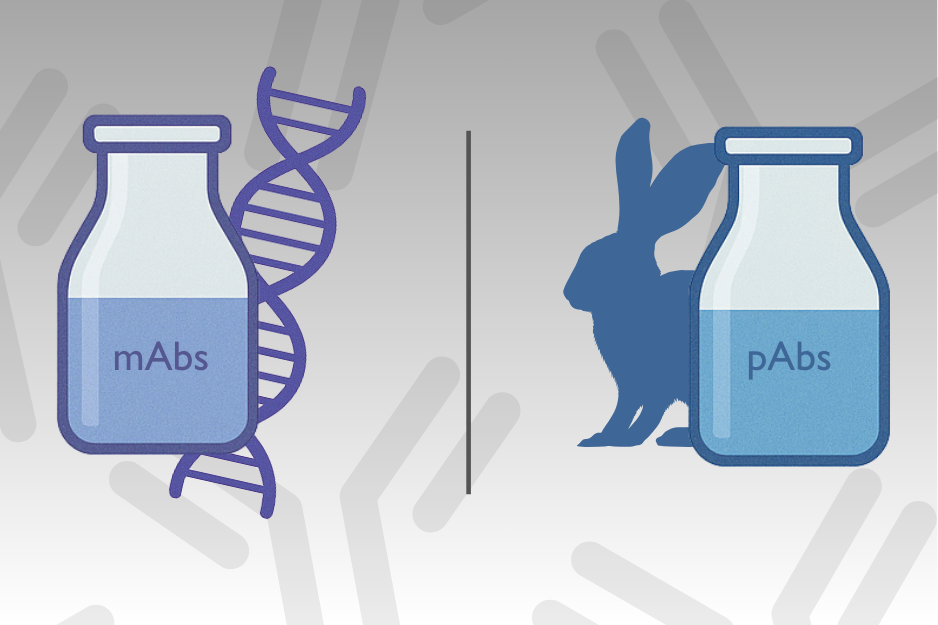
Recombinant mAbs vs. Polyclonals: How do You Choose?
Antibodies are research powerhouses, but batch-to-batch variability can derail experiments. Recombinant monoclonal antibodies (mAbs) are often touted as the
consistency champions. But are they always the best choice? Let's cut through the noise.
The Core Difference: Production Defines Consistency
- Recombinant mAbs:
- Made By: Cloning specific antibody genes and expressing them in controlled cell lines (e.g., CHO cells).
-
Consistency Edge: A defined DNA sequence means every batch is genetically identical. Advanced manufacturing minimizes drift. Studies show >95% batch consistency. The sequence can be stored and shared for perfect reproducibility.
- Polyclonal Antibodies:
- Made By: Immunizing animals (e.g., rabbits), collecting serum, and purifying the mix of antibodies produced.
- Consistency Challenge: Biological variability reigns. Animal health, immune response and antigen prep differences lead to batch variations in antibody mix and performance. Recreating an identical batch is nearly impossible.
Verdict: Recombinant mAbs have a clear, inherent advantage in production consistency due to genetic control.
Specificity vs. Robustness: The Epitope Factor
- Recombinant mAbs:
- Target one specific epitope. Ideal for precision tasks (e.g., flow cytometry, quantitative ELISA).
- Consistency: Performance is extremely consistent if the target epitope is unchanged (SPR variations as low as 0.1%). However, if the antigen structure varies (e.g., denaturation), effectiveness can drop sharply.
- Polyclonal Antibodies:
- Target multiple epitopes on the antigen.
- Consistency: Epitope diversity provides robustness against antigen changes or minor prep variations, sometimes masking batch differences in qualitative assays (e.g., IHC). However, the mix of antibodies can vary significantly between batches, leading to inconsistency (e.g., up to 20% signal variation in ELISA vs. <5% for mAbs).
Verdict: Recombinant mAbs win on pure consistency for defined targets. Polyclonals offer robustness in complex scenarios, potentially reducing perceived variability in some applications.
Where to Use Which: Application Matters
- Choose Recombinant mAbs For:
- High Specificity & Reproducibility: Quantitative assays (ELISA, SPR), therapeutic studies, clinical diagnostics (e.g., HER2 detection), longitudinal/multi-lab studies. They minimize variability for precise target detection.
-
Limitation: Single-epitope focus can be weak in complex samples (e.g., tissue) if the target site is obscured.
- Choose Polyclonal Antibodies For:
- Robustness & Sensitivity: Immunohistochemistry (IHC), Western blot, immunoprecipitation, detecting low-abundance/variable antigens, exploratory research with poorly characterized targets.
- Limitation: Batch variability is problematic for quantitative work. Requires optimization per batch.
Other Quick Considerations
- Stability: Recombinant mAbs offer better engineering control for long-term stability, but both types face aggregation/degradation risks if storage isn't perfect. Polyclonals can tolerate minor degradation better due to diversity.
- Cost & Access: Recombinant mAbs are expensive (complex production) but reproducible globally. Polyclonals are cheaper and more accessible for small labs but inherently less consistent and face animal use/replication limitations.
The Future: Convergence?
- Recombinant mAbs: AI-driven optimization and better bioprocessing are reducing costs and further improving consistency (e.g., predicting glycosylation). Simpler formats like nanobodies show promise.
- Polyclonal Antibodies: Synthetic libraries might improve consistency while keeping robustness, but matching recombinant precision is distant.
-
Hybrid Strategies: Combining recombinant mAbs (specificity) with polyclonals (amplification) offers a balanced approach.
The Bottom Line
Recombinant monoclonal antibodies are the undisputed leaders in batch-to-batch consistency due to their genetically defined, controlled production. They are the gold standard for applications demanding high specificity and reproducibility. However, polyclonal antibodies are not obsolete. Their epitope diversity provides crucial robustness and sensitivity in many research contexts, like IHC or Western blotting, where their inherent variability might be less impactful in qualitative assessments.
The question isn't "which is better?", but "which is better for my specific experiment?" Prioritize recombinant mAbs for precision and reproducibility. Leverage polyclonals for robustness, sensitivity, and cost-effectiveness in qualitative or exploratory work. Understanding this trade-off is key to reliable research.