
Secondary-Free Western Blot? Why Direct-Labeled Primaries Are Worth a Try
Choosing the right detection method for your Western Blot experiment can sometimes be tricky. Both direct-labeled primary antibodies, such as HRP-conjugated antibodies, and the classic “unlabeled primary + HRP-secondary” approach have their own strengths.
In this post, we’ll walk through their pros and cons and help you decide which one fits your needs best.
1. How Each Method Works
Traditional Method (Indirect Detection)
Unlabeled primary antibody binds to the target protein on the membrane → wash → HRP-labeled secondary antibody, which recognizes the primary antibody, binds → wash → add ECL substrate and image.
Direct-Labeled Method (Direct Detection)
Primary antibody is already conjugated with HRP → direct incubation with the membrane → wash → add ECL substrate and image.
2. Advantages of Direct-Labeled Primary Antibodies
✓ Cleaner Backgrounds— No More Secondary-Related Mess
One of the biggest headaches in traditional WB is background caused by secondary antibody cross-reactivity, especially when detecting proteins in tissues that contain endogenous immunoglobulins, such as mouse tissues with mouse antibodies. With direct-labeled primaries, there is no secondary antibody, so cross-reactivity and non-specific binding from the secondary antibody are completely eliminated.
Additionally, if you choose recombinant monoclonal antibodies, like those from Bioss, you get an extra layer of cleanliness. Recombinant monoclonals are produced by gene engineering, avoiding animal-derived contaminating proteins. This means higher specificity, extremely clean backgrounds, and excellent batch-to-batch consistency, making your results more reliable and reproducible.

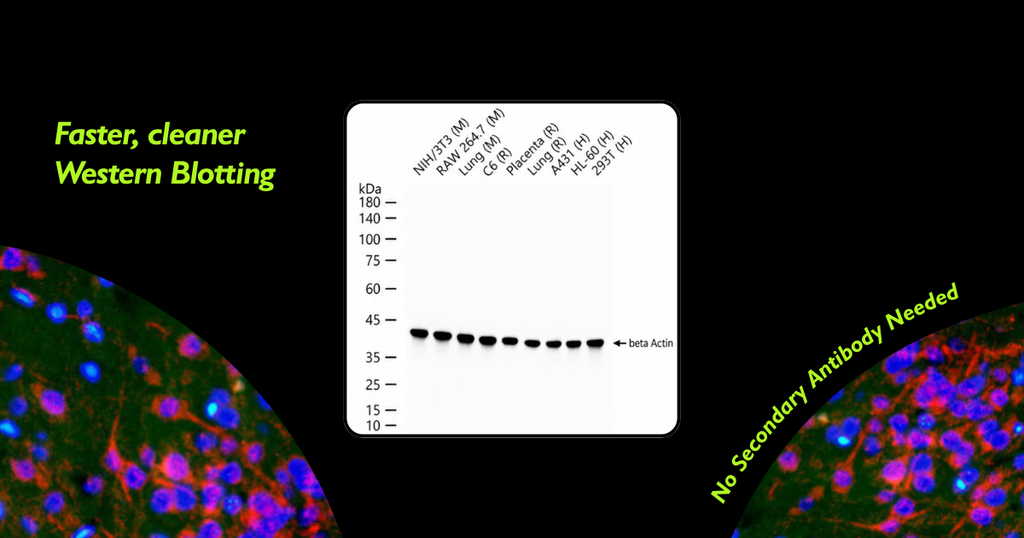
Figure 1. Detection of β-actin in various cell lines and tissue lysates using Bioss recombinant anti-β-actin-HRP monoclonal antibody. Total protein lysates from the indicated sources were separated by SDS-Page and transferred onto a membrane. The membrane was incubated with Bioss bsm-63325R-HRP antibody at a dilution of 1:1,000,000, followed by ECL detection. A single clear band at the expected molecular weight (~42kDa) was observed in all samples, demonstrating the antibody’s broad species cross-reactivity (mouse, rat, human) and excellent specificity with extremely low background, even at an ultra-high dilution.
✓ Time Saving
- Traditional method: Primary incubation, 1 hour or overnight → wash 3 × 10 minutes → secondary incubation, 1 hour → wash 3 × 10 minutes → image.
- Direct method: Direct-labeled primary incubation, 1 hour → wash 3 × 10 minutes → image.
You save at least 1.5 hours, which is a big win when you have multiple membranes to process.
✓ Multiplexing Made Easy
Want to detect two proteins on the same membrane, such as a total protein and its phosphorylated form?
Traditional multiplexing requires primary antibodies from different species plus two different secondary antibodies, such as anti-rabbit HRP and anti-mouse AP, often with stripping or fluorescence. This can be complicated and prone to crosstalk.
With direct-labeled antibodies, you can simply mix an HRP-conjugated antibody against target A and an AP-conjugated antibody against target B, incubate together, wash, and develop sequentially with two substrates. Simple, clean, and reliable.
✓ Better Reproducibility
Fewer steps mean fewer variables. The direct method reduces user-dependent variation and reagent batch differences.
Recombinant monoclonal technology adds even more consistency. Because the antibody is produced from a defined genetic sequence, every batch is virtually identical. This means no more worrying about animal-to-animal variation that can happen with traditional polyclonal or even hybridoma-based monoclonal antibodies.
3. The Strengths of the Traditional Indirect Method
✓ Higher Sensitivity & Signal Amplification
In the traditional approach, one primary antibody can bind multiple secondary antibodies, especially polyclonal secondaries, which have 2–4 binding sites. This provides signal amplification. That makes the indirect method superior for detecting very low-abundance proteins, such as endogenous transcription factors or some phosphoproteins.
✓ Flexibility— One Secondary Works with Many Primaries
If you have a limited budget or are exploring new targets, buying an unlabeled primary and a universal secondary is more economical. You can also reuse primary antibody solutions, though this comes with some risk of degradation.
4. Which Method Should You Choose?![]()


5. Quick Comparison Table ![]()

6. Practical Tips for Direct-Labeled Antibodies
-
Start with Your Housekeeping Control: Buy a direct-labeled β-actin or GAPDH antibody, such as an HRP conjugate. You’ll appreciate the speed and clean background.
-
For Low-Abundance Targets, Try a Super-Sensitive ECL Substrate: If you’re worried about sensitivity, don’t give up. Substrates like Femto or Clarity Max can often rescue weak signals.
-
Consider Recombinant Monoclonal Direct-Labeled Antibodies: Brands like Bioss offer well-validated HRP-direct recombinant monoclonal antibodies. Their recombinant technology ensures high specificity, extremely low background, and consistent performance from lot to lot, making them a strong choice when you want both convenience and reliability.
-
Label Your Own Antibody if Budget Is Tight: Commercial labeling kits allow you to conjugate HRP to your purified antibody at a reasonable cost.
7. Final Thoughts
Neither method is “best” for everything. The right choice depends on your target abundance, time, and budget. For speed, clean backgrounds, and multiplexing, go direct-labeled, preferably with a high-quality recombinant monoclonal antibody, like those from Bioss, for the best specificity and consistency. For maximum sensitivity or when working with very precious primaries, the traditional indirect method is still your friend.
Try adding a few direct-labeled antibodies to your toolbox. You might be surprised how often they make your Western Blot life easier.