


Unveiling the Power of HRP Polymer Detection in IHC
When you peer through a microscope at a stained tissue sample, the vivid clarity of highlighted proteins is often thanks to immunohistochemistry (IHC). This cornerstone technique enables researchers and pathologists to visualize specific proteins, or antigens, within cells and tissues, making it essential for diagnostics and biomedical research.
What elevates IHC to extraordinary precision? The answer is HRP polymer detection—a highly sensitive, streamlined method revolutionizing signal detection in IHC. In this article, we’ll dive into how it works, how it stacks up against traditional methods, and why it might be the right choice for your lab.

A Quick Primer on Immunohistochemistry (IHC)
Immunohistochemistry is a laboratory technique used to identify specific proteins, or antigens, in tissue samples. By applying antibodies that bind to these antigens and then using a detection system to create a visible signal (typically a color change), IHC allows scientists to see exactly where a target protein is located.
Traditional detection methods such as the avidin-biotin complex (ABC) or standard HRP-labeled secondary antibodies have been trusted for years. However, they can introduce challenges like background staining or limited sensitivity, often requiring extra steps to optimize results.
Introducing HRP Polymer Detection
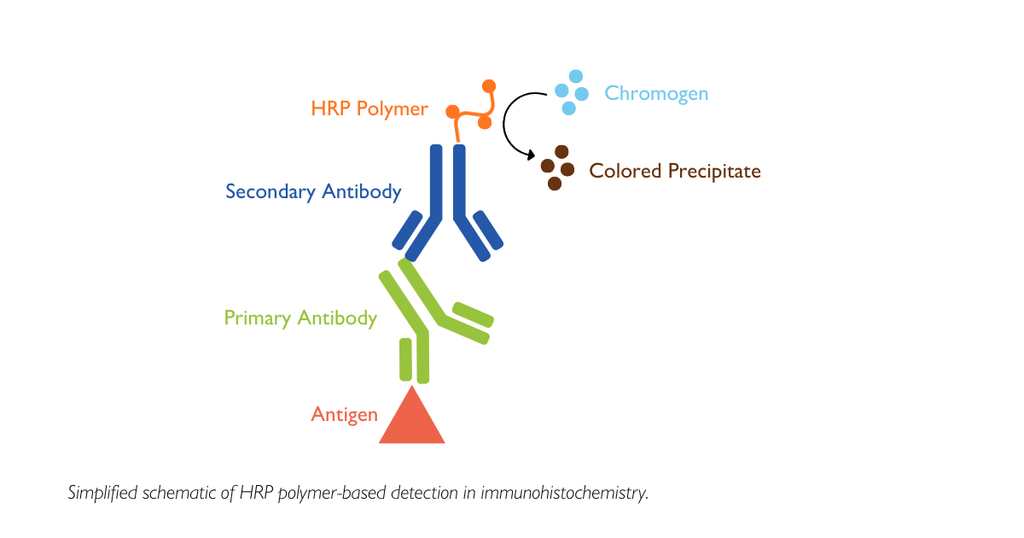
HRP stands for horseradish peroxidase, an enzyme that reacts with a substrate (such as DAB, or 3,3'-diaminobenzidine) to produce a colored precipitate at the site of the target antigen. HRP polymer detection elevates this concept: instead of attaching just one or a few HRP enzymes to a secondary antibody, this method uses a polymer backbone that carries dozens of HRP molecules. This polymer is then linked to a secondary antibody, creating a powerhouse of signal amplification in a single step.
Even better, HRP polymer systems are often biotin-free, which helps eliminate false positives caused by natural biotin in certain tissues like liver or kidney, making them ideal for detecting low-abundance antigens with exceptional clarity.
How HRP Polymer Detection Works
The workflow for HRP polymer detection is straightforward:
- Apply Primary Antibody: A specific antibody binds to your target antigen in the tissue.
- Add Polymer Conjugate: A polymer-linked secondary antibody loaded with multiple HRP enzymes binds to the primary antibody.
- Introduce Substrate: A chromogen like DAB is added. HRP converts it into a colored, insoluble precipitate.
- Visualize and Analyze: After counterstaining, the sample is ready for microscope examination.
This method can be adapted for one-step or two-step protocols, and its high enzyme density means stronger signals with less background.
Key Benefits of HRP Polymer Detection
HRP polymer detection offers compelling advantages for researchers and pathologists:
- Superior Sensitivity: Detect low-abundance antigens easily, even with diluted primary antibodies.
- Biotin-Free: No interference from endogenous biotin, which is especially useful in liver, kidney, or other biotin-rich tissues.
- Streamlined Protocol: Reduce steps and save time without losing signal quality.
- Cleaner Staining: Enjoy low background and high contrast for easier interpretation.

Real-World Impact
HRP polymer detection shines in diagnostic pathology, particularly for identifying phosphorylation markers or tumor-associated antigens. It delivers clear, high-contrast staining with minimal background, outperforming traditional methods when targeting faint or sparse antigens. Side-by-side comparisons consistently show that polymer-based systems provide more specific, reliable, and visually striking results than conventional HRP-secondary antibody staining.
Conclusion: Enhancing IHC with HRP Polymer Detection
HRP polymer detection is a transformative advancement in immunohistochemistry, offering unmatched sensitivity, reduced background, and a simplified workflow. Whether you're in a research lab or diagnostic setting, this method can significantly enhance your results. If you haven’t tried it yet, consider testing Bioss HRP polymer systems on one of your routine IHC assays. You’ll likely discover improved clarity and efficiency that takes your work to the next level.
Shop Bioss HRP Polymer Kits by clicking here.